This western saloon photograph is absolutely authentic, right down to the bobcat... except for one thing. Research and common sense dictate that the girl, the saloon girl in the front, she never happened. At least not like this... and that is why after a tremendous hunt over a decade, I had to fake this photo... ***************************************************************************************
The myth of the Old West saloon girl being admitted in the previous blog (see below), I thought it would be interesting to try to trace back, and ask, how did Hollywood get it so wrong? ***************************************************************************************
Where did our beloved, scantily clad, frontier alcohol schleppers come from? If they are a myth, what on earth were the writers and producers and directors of many hundreds of films and television shows thinking? It could not have been education, or history, or the truth... what might have been their rationale? And why did millions of Old West fans tolerate it? ***************************************************************************************
Besides the fact that sex sells... ***********************************************************************************

Sure there were “saloon girls”... but in most cases far different from what has been repeatedly depicted on television and in the cinema. When we search the historical photographic record, we can not find any basis for the icon well established in our Western culture; The brazen hussy, slinking around Hollywood-created saloons, wearing as little as possible, except for a ridiculous hat topped with a colorful plume which adds to her slink... her skirt removed from her front, allowing full disclosure of her thighs, but following in tassels behind like a vapor trail.
Young women, and men, enjoy role-playing... of stereotypes which never existed. *****************************************************************************************
She hangs around the saloon, dressed to kill, chronically bored, dutifully entertaining enthusiastic cowboys, who are determined to make fast friends and end up in a bed somewhere, or anywhere, barely learning these girl's names. It was highly suggestive, sex on demand. But fees for services rendered never come up in the dialog. You were supposed to know what it was all about... if you did not, then you were probably too young to understand these things.

Little boys, who watched it all in admiration and wonder, could never understand that this was the beginning of their lifelong Hollywood acculturation, which presented women as primarily objects of sexual desire- professionals in fact, who should be waiting at a saloon near you, ready to pour you a drink, make you feel good, arouse your passion and then succumb to it as a matter of obligation. Man, would most of them be disappointed. *****************************************************************************************
Playboy magazine picked up this male-oriented cultural expectation when Westerns began to fade from the daily fare, ensuring that American boys turned into unhappy sexual tyrants in adulthood. We can never measure the negative impact these shows had on our youth and mental development. American boys grew up wondering... where were all of those beautiful, sexy girls who were so accommodating to those smelly, dirty, lucky cowboys? *****************************************************************************************
Most of us shrugged at the myth- it was fun, if not artistically amusing, even if it was as realistic as the freaks in Star Wars. Who knew? Who lived back then, so who could verify one way or another? Who could prove that these Western tarts were any more or less real in our past than those Star Wars creatures might be in our future? And so they persisted till this very day. Western reruns insure the eternal existence of the saloon girl myth, regardless of her origins in the salacious minds of Hollywood creatives who made her as American as the Statue of Liberty. *****************************************************************************************
And since there was such a dearth of historical evidence of western saloon female employees, and such a great demand to use females in western productions, it was only natural, good business, to give the public what it wanted. Besides, nobody wanted to watch prostitutes cavorting in the saloons as they actually did, taking reservations, hustling customers with not-so-subtle advertisements using innuendo unfit for children's ears. The saloon girl, whatever she had been, became the Hollywood solution, a convenient cultural amalgamation, a deliberate conflation of saloon girl, bar maid, dance hall girl, vaudeville entertainer and prostitute. And that was not only simplistic, and unrealistic, it was a slam on almost all of the women who ever worked in a saloon.

So here is the process as I understand it... how so many innocent working girls in saloons all across the West became fancy vixens of shame. The assumptions which created the Western saloon girl, which went unchallenged for nearly a century, were that since women in the Old West were fairly rare, and would have to have been crazy or desperate to find themselves in these hell towns, if they were not prostitutes when they came, they probably joined the sex-trade soon afterwards. Or they certainly hoped so. Hollywood ordained that they gladly accepted jobs in these combo bar/dance hall/brothel/opera houses and dutifully provided whatever services paid the best. Westerns perfunctorily skimmed over the cooks, maids, seamstresses, nurses, teachers and other female towns-persons... and made the saloon girl the jacke of all trades...

But what would she have looked like, this wonder girl of pleasure- how might she have presented herself? Hollywood designers could find very little evidence for a saloon girl “look,” no fashion which said, “I am your waitress and entertainment for the afternoon... let me fetch you a cigar, or a beer, or some sex.”
Saloon barmaids, and there were a few, wore aprons and bonnets or hair nets, and were sweaty from their toils.
Prostitutes usually wore very un-sexy attire, so as to not flaunt their lawlessness. They tried to keep a fairly low profile, wearing clothing which conservatively covered them from neck to toe. In the brothels they often wore large, shapeless white gowns, which looked like frilly smocks. Around town they would be hard to pick out in a crowd... except that they might have been wearing the most beautiful and expensive clothing in town.
So Hollywood turned to Vaudeville for inspiration. It was known that Vaudeville entertainers came through the larger towns regularly, and the female Vaudevillians often wore very suggestive costumes. In fact, these entertainers, professional singers, musicians, rope-jumpers, poetry reciters, and dancers, wore scandalous outfits condemned by everyone but those who paid to see them. They were wild, and colorful, and unforgettable. Here was a Pandora's box of sexy costumery.

Understand, the women who donned these outfits were amazing, hilarious, brilliant and brave professionals, and even sometimes talented, who traveled in companies well protected by male bodyguards. Nobody got near them. Money, gold and silver nuggets were thrown upon the stage, as lonely, love-struck miners and cowboys emptied their pockets in adoration... but it got them no closer to their latest sexual fantasy. These bizarre sirens of the stage, bedecked in flamboyant wigs, low-cut blouses, colorful stockings and frilly short-shorts, were untouchable, not available at any price, at least to the common folk. They may or may not have made themselves available to prominent gentlemen callers, but only ones who would lavish expensive gifts, rather than money. Their costumes were their stock and trade, not to be touched and felt and grabbed by the unwashed.

Saloon girls did not wear such things. They had to wear practical clothing. In a single night, they might have to fend off several drunks, dodge cigar ashes, dance with a dozen men, carry a half-dozen mugs of beer across the floor, many times, trying not to spill some along the way, and getting some on their dress... which had to be washable, because accidents happen. And maybe daily. And they had to constantly wear a smile, so that the customers would buy more alcohol, on which they received commissions on the sales.

Saloon girls were sales personnel. If they were not too busy, they might agree to a dance with a cowboy or two... fellows they liked, who understood that they had to pay for that pleasure too. Then at closing time they had to turn in their receipts and clean up the place after fifty drunks had trashed the place. They wore working girl clothes... and maybe some ribbons or a little jewelry to make themselves feel attractive... but they wore their hair short, to avoid beer and slobber, and their dress was only a few inches shorter than the average woman on the street. NOBODY ever saw their legs, or their chest, and certainly not any cleavage.

The very first entertainers in Western saloons were probably flamenco dancers and the guitarists and fiddlers who accompanied them. “Spanish” music was often the fare, and “Spanish” flamenco dancers were known to wear more suggestive clothing... low cut blouses, a sexy flower in their hair... a person might be able to see their calves when they twirled. Sometimes Irish music found its way into the saloon.
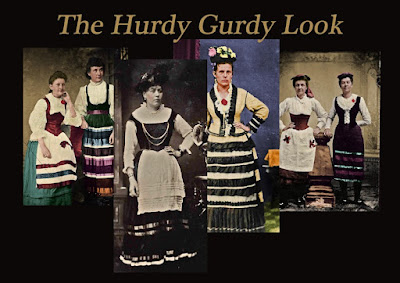
Later German polka music, played by “Hurdy-Gurdy” girls became the standard. A hurdy-gurdy was a German instrument, which was played by a musician in the old country while a girl danced for tips... The name became synonymous in America with “dance hall girl,” female entertainer, or anything “proper folk” imagined went on in such questionable places.
The idea that saloon girls served drinks all night and then suddenly hopped up on a stage and broke into the can-can dance is absurd. Most saloons had no stage. When they did, these dances were provided by traveling entertainers, who (usually) would not be caught dead waiting on drunks, or wrestling with them. These dances and short plays were a special treat, and not always available. But the prostitutes were, and were allowed to hang around the place, daily, as long as they behaved. It is said that they usually paid a commission to the bar owner.

Many saloon girls were just poor country girls forced into work to survive. A significant percentage fell into the sex-trade, but more ended up getting married and putting those days behind them. Out West, propriety had little to do with status. A predominance of the most famous men of the Old West were either pimps or whore-mongers. A saloon girl had little to fear, in a place where a person's reputation was enlarged by their counter-cultural behavior. *****************************************************************************************
Saloon girls were not necessarily dance hall girls. Sometimes, often times there was also no dance floor available. Besides the fact that they were often quite busy, and unable to make themselves as attractive, saloon girls were usually not the apple of the average customer's eye... *****************************************************************************************

Dance hall girls, like the ones above from Arizona, were employed at large dance halls, sometimes adjacent to saloons, but not always. These halls featured professional bands, and more refined atmosphere, and more importantly, the girls where usually more attractive, younger women, whom men were willing to pay to be next to. If they were not attractive, men in the West learned not to be that selective. They were at least, WOMEN! It was not unheard of for miners or lumberjacks or cowboys to dance with each other when women were too scarce. A woman of any kind was a treasured thing.

“Hurdy-Gurdy” or dance hall girls were usually dressed well, and had no other responsibilities... and they would dance with you if their card was not yet full. A dance card was the prepared list for the evening's music, which each girl carried, and male dancers would reserve dances with certain girls for certain songs. The men had to pay, so it was not often that a girl was all tied up by just one partner. If she was, this was the equivalent of “going steady.”

These women wore dancing gowns, often with a minimal bustle, often a nice white dress which had previously been a confirmation dress... or somebody's wedding dress. The hems were kept above the heels to prevent tripping... so ankles were barely visible. They “spruced up” these make-do ballroom dresses with ribbons and perhaps a corsage... but necklines were kept very proper... but open at the base of the neck to allow for ventilation. Those halls got terribly warm. Hair, again was kept short, or tied up to stay out of the way. Men were bad about wanting to stroke and pull it... best to keep it out of reach. *****************************************************************************************
Remember, these courageous young women were often dancing with total strangers, being held, twirled, and dragged about like rag dolls. Often times these dance partners were tipsy, or worse, and not always polite or gentle. These dance hall girls earned their money, as dancing all night took energy and some skill, and tons of patience. It was often a dance hall girl who taught a new dancer how to dance...

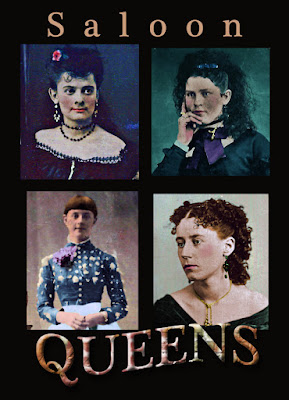
those Victorian female icons of frontier fun? "Saloon girls," or bar maids, or whatever they may have been called; they may have been pretty boring looking in the beginning, compared to the Hollywood vision of them... Here are some images I have collected over the decades... and digitially restored... and colorized, to try to capture the spirit of the times.

When we consider the various women and the purposes they served in association with the Western saloon, we cannot find a single one which would have worn the sexy, fancy outfits we are accustomed to seeing in every Western. Each job had its demands, and each its suitable attire. So typically, Hollywood just stuck them all in French Can-Can costumes, and ran with it; Bar maids, saloon girls, dance hall girls, prostitutes, all the same. Imagine if every man in the same Western was dressed as a circus performer... and you might begin to fathom the silly, shallow, inexcusable absurdity. We have been brain-washed by sexist, lascivious lies.

And no wonder young American couples quit meeting one another's naive expectations... and divorce rates sky-rocketed, and homo-sexuality with them... and all of us red-blooded American males grew up believing in SALOON GIRLS, and lots of other Hollywood myths. If you are still shaking your head in disbelief, read LEGENDARY WATERING HOLES, The Saloons That Made Texas Famous, 2004, Texas A&M Press. Here several authors explore the most famous saloons in Texas, and the cultures in which they thrived... and struggled. Saloon girls are never even mentioned. You cannot find the term in the book index. According to this book, they were not even a thing.
The closest acknowledgment of any semblance of saloon girls was Chuck Parson's chapter on the Iron Front Saloon in Austin, where he compared Austin's strict written and unwritten codes about women in saloons to those of San Antonio. San Antonio was more like El Paso, as in wide open, and Jack Harris had
"female drink servers" at his Vaudeville Saloon and Theater, which would have been illegal and unwanted in Austin, where saloons were proudly reserved "for men only." ************************************************************************************************
The myth of the American saloon girl is like the sun, The more we look at her, the blinder we get, and the less we can see anything. The term "Saloon Girls," in most instances, appears to have been merely a euphemism, a nice way to identify a possible prostitute without using an ugly word... because in many major cities, even by the 1880's, prostitution was frowned upon if not illegal, and any woman inside of a saloon was assumed to be a whore. Most saloons which were owned by women were in fact fronts for brothels. Ginnie Banters in Jerome, Arizona, Lottie Deno's in Jacksboro, Texas and Silver City, New Mexico, had saloons in tandem with their brothels.

There were saloon girls, but most saloons were off limits to all women... and saloon girls probably evolved over time as saloon proprietors got married and their wives helped out in the family business. Female saloon employees were predominantly drink servers, bar maids, and would probably have been insulted if someone called them a "saloon girl," which originally meant a woman involved in the sex trade. When a bunch of indignant female saloon employees banded together to change their public image in Cripple Creek, Colorado, and made public appeals, they referred to themselves as "dance hall girls."

They were working girls... actually some of the first in the country not employed in sweat shops, and proud to have jobs, even if these jobs required no small amount of humiliation. They fiercely held on to their self-respect, and resented the stereotype promoted by the newspapers and "proper" society, and demanded more respect from both. They would have been very put-out with how they have been depicted for the past one hundred years... *********************************************************************************************** Only Hollywood could have or would have ignored such a large and important demographic, all while they contrived a genre that barely existed, if at all, while making the world's oldest profession a glamorous, iconic, and ubiquitous institution in our imagined past. Read on and get an introduction to the REAL dance hall girls of the American west...




 A sixth generation Texan, landscape painter, sculptor, photographer, writer and historian, Russell Cushman shares his passion for the music, art and history of the Brazos Valley.